Polar Vortex

The Arctic climate warms four times faster than the global average. Summer sea ice extent has plummeted by roughly 30% over the past 30 years, and up to 90% of the oldest, thickest ice has vanished. This is transforming geopolitical calculations for trade, strategic resources and security.
Around 13% of the world’s undiscovered oil and 30% of its undiscovered natural gas are thought to be in the region, both becoming more accessible as the ice recedes.
Vast stretches of the Northern Sea Route (NSR) – hugging the Siberian coast from the Bering Strait to the North Sea – are now seasonally ice-free, allowing voyages between East Asia and Europe of around a week faster than via Suez.
The current ramping up of aggressive trade policies, scrambles for strategic minerals and realignment of security alliances is pointing towards a showdown in the Arctic.

This is an opportunity for the UN to demonstrate how it could function in a more complex and fraught international environment. It would need to learn to shift gears between different complex domains, mediate across more fluid political alignments, learn new technical areas expertise, and invest in new operational capabilities across resource governance, security and trade.
Amid competing P5 interests, success here could revive the UN’s value in an increasingly fragmented world. Demonstrating that win-win deals are achievable between the great powers could open opportunities for more innovative diplomatic strategies and governance structures.
Arctic militarization
Arctic militarization is reshaping global geopolitics. After floating the idea in 2019, Trump is now pursuing U.S. acquisition of Greenland on national security grounds. Greenland already hosts the U.S. Thule Air Base (missile warning and space surveillance) and is believed to contain enormous deposits of rare earth elements, precious metals, and hydrocarbons.
Canada agreed on a comprehensive modernization of NORAD with the U.S. to improve early warning systems over Arctic airspace. Joint military exercises in Arctic conditions have become routine: in 2023 U.S. and Canadian forces held drills on Greenland’s icecap, practicing air defense operations, and the Canadian Navy led war games with U.S. and UK allies in the Arctic Ocean.
Roughly 53% of the Arctic Ocean’s coastline is under Russian jurisdiction. Key assets like the LNG terminals in Yamal and strategic ports like Murmansk lie in the far north. Over the past decade, Moscow has constructed or upgraded approximately 475 military sites along its Arctic frontier: bases, airfields, radar stations, submarine pens, air defense systems and barracks along its northern coastline. Russia has equipped its Arctic units with nuclear-capable missiles and hypersonic weapons, integrating the far north into its strategic deterrent posture, the world’s only fleet of nuclear-powered icebreakers escorting warships through frozen seas.
Russia has created a dedicated Arctic Command and is beefing up its coast guard and air patrols, leading the Arctic militarization race and controlling a new strategic choke point.
Foreign ships must request permission and take on board Russian ice pilots when using the NSR. The question is whether the NSR will evolve more as an international corridor (with shared rules and international oversight to guarantee passage rights) or remain Russian controlled.
Russian air bases are within striking distance of Scandinavia, and precision missiles could target Arctic sea lanes.
NATO has also ramped up its Arctic wargames and surveillance.
The Arctic remains “a dark area" on NATO maps, with sparse radar or satellite coverage, making it hard to monitor. The U.S. is investing in new polar security cutters. NATO allies have conducted joint naval operations in the Barents and Bering Seas, and China and Russia have conducted joint naval maneuvers near Alaska.
Critical infrastructure
Securing the Arctic depends on protecting and developing critical infrastructure – internet cables, satellites links, oil rigs, and power grids. Arctic states are considering stronger cooperation on situational awareness and search-and-rescue.
New data cables through the Arctic could cut internet latency between Europe and Asia. In early 2022, one of the two undersea fiber-optic cables connecting Svalbard to mainland Norway was severed on the Arctic seabed. A few months prior, another nearby undersea cable had been torn away. Norwegian investigators concluded that the Svalbard cable was likely deliberately sabotaged. Around the same time, saboteurs blew up sections of the Nord Stream gas pipelines in the Baltic Sea.

Sweden and Finland’s NATO accession, brings Arctic-ready forces, strategic positions (like Gotland), and enables deeper defense planning. The EU has also been investing in environmental protection, indigenous peoples, and infrastructure connectivity in the region, linking Arctic climate action to its broader Green Deal and critical raw materials strategy.
Norway maintains its sovereign stance on offshore oil and gas drilling, issuing licenses for exploration in the Barents Sea and asserts that Arctic resources remain essential to European energy security. NORDEFCO, the Nordic defense cooperation forum, has gained new prominence. A more unified Western approach to Arctic security brings interoperability from North America to Northern Europe – but also a more pronounced dividing lines with Russia. The Organization for Security and Co-operation in Europe (OSCE) could though be a platform for Arctic confidence-building measures that include Russia.
Arctic shipping routes
The Arctic could have completely ice-free summers as soon as the 2040s. The opening of previously impassable waters has even raised the prospect of a Transpolar Sea Route straight across the North Pole in the future.
A long-running diplomatic disagreement persists over the status of the Northwest Passage – the shipping route winding through Canada’s Arctic archipelago. Canada regards the passage as internal territorial waters; the U.S. views it as an international strait open to global navigation. For now Washington quietly asks permission for its icebreakers to transit, and Ottawa routinely grants it.
Russia is courting shipping away from the unstable waters in the Middle East, investing about €20 billion through 2035 to develop the NSR’s infrastructure.
In 2018 Beijing declared China a “Near-Arctic State”, envisioning the Arctic as part of its belt-and-road network, marketed as the “Polar Silk Road.”
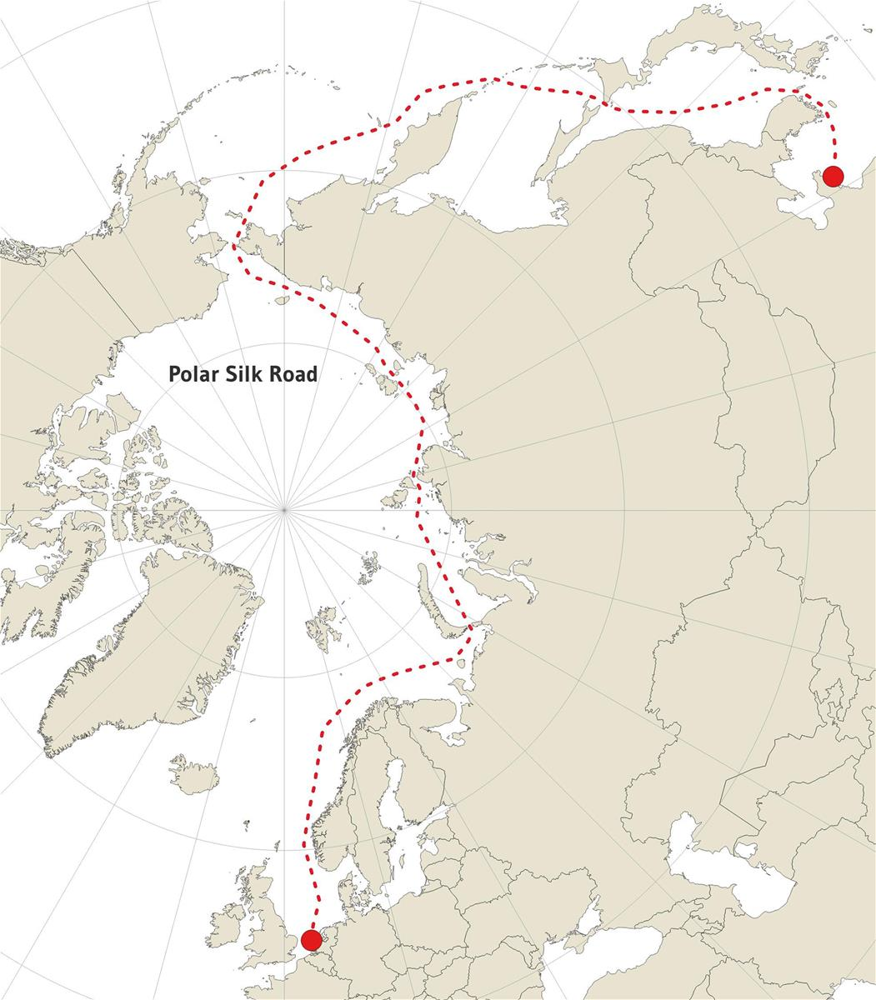
Chinese shipping conglomerates have sent trial voyages through the NSR, and state-owned companies have invested heavily in Russia’s Arctic energy megaprojects, binding China to the success of Arctic commerce. China is operating research stations in Norway’s Svalbard (Yellow River Station) and Iceland, sending icebreakers on research expeditions, and engaged in high-profile proposals to build airports and other infrastructure in Greenland and Finland. In 2024, China sent icebreakers into Arctic waters to conduct research and demonstrate operational reach.
The Bering Strait – only 85 km wide at its narrowest – is a crucial chokepoint. Any ship transiting between the Pacific and Arctic Oceans must pass between Alaska and Chukotka. In a conflict scenario, the Bering Strait could be closed off.
Critical minerals and energy security
Over the past two decades, there has been a slow-motion Arctic oil rush. There is a strategic storehouse of critical minerals in the Arctic that could shape the future balance of economic power. From Norilsk Nickel in Siberia to potential Arctic seabed mining. A disproportionately large share of global hydrocarbon reserves are understood to lie in the Arctic circle, much of it offshore on the extended continental shelves of Russia, Norway, Alaska, Canada, and Greenland.
Russia has developed giant gas fields on the Yamal Peninsula and in the Kara Sea, and it continues exploratory drilling even in remote East Siberian waters. The U.S. has periodically pushed to drill in Alaska’s Arctic National Wildlife Refuge and recently approved the “Willow” project on the North Slope, citing the need for energy security. Norway has expanded oil and gas extraction into the Barents Sea. And Greenland, though it banned oil exploration in 2021 due to environmental concerns, still allows mining and could reconsider hydrocarbons under different political leadership. Each of these ventures brings competition and sometimes conflict. U.S. sanctions on Russia have targeted Arctic offshore drilling technology transfer, slowing some Russian projects, while environmental groups and indigenous communities have legally challenged Arctic drilling plans in the U.S. and Canada.
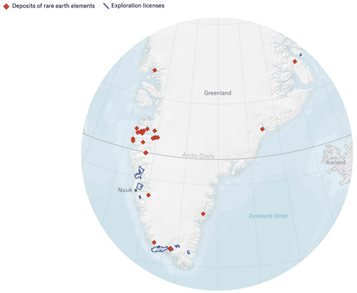
Vast swathes of the Arctic contain metals like nickel, copper, cobalt, and rare earth elements, vital to new tech and energy industries. Greenland’s rare earth deposits are drawing intense international interest. Rare earth elements (like neodymium, dysprosium, etc.) are key for wind turbines, electric vehicle motors, and advanced electronics, currently China dominates their global supply. In 2023–24, both the EU and U.S. signed agreements with Greenland to jointly develop mining projects to secure critical mineral supplies, aiming to reduce reliance on China. Chinese firms had invested in Greenland’s mining sector but are largely sidelined.
Amid this rush, the Arctic environment is extremely fragile.
Ecosystems are slow to recover from disturbances. An oil spill in icy waters is a catastrophic event. Cold temperatures and sea ice make cleanup near impossible and oil degradation extremely slow. Indigenous peoples – including the Inuit, Saami, Chukchi, Nenets, and others – depend on a healthy Arctic environment for their livelihoods (fishing, herding, hunting) and cultural survival. Climate change is already disrupting animal migration routes and thinning the sea ice that communities use for travel. Industrial development is harming marine life, disturbing ecosystems, and accelerating emissions.
Environmental protections cover at least part of the region (a moratorium on fishing in the Central Arctic Ocean was agreed in 2018). Organizations like the Inuit Circumpolar Council demand co-management and respect for indigenous land rights before mines or rigs go up.
The scientific value of Arctic cooperation – from understanding climate feedback patterns to discovering new species – is a global public good in itself.
UN Arctic governance
With every Arctic neighbor now in what Moscow deems a hostile alliance, the traditional venues for pan-Arctic dialogues – such as the Arctic Council – are strained. After Russia’s Ukraine invasion, the Western Arctic states boycotted Arctic Council meetings, halting its work.
China obtained observer status in the Arctic Council in 2013. This is posing challenges for including major consumers of Arctic resources (like China, India, Japan) in its governance, while respecting the sovereignty of its nations, and the rights of its indigenous peoples.
The Arctic Council lacks treaty status and excludes security issues. Its consensus-based, science-driven approach stalled with Russia’s ostracization. Integrating the Council’s work within formal UN processes may give the Arctic a route to the governance it needs.
The UN should be able to make a case to develop a comprehensive multilateral framework for the Arctic, across at least five key areas:
- The main test for the UN would be creating confidence-building measures around Arctic security: notification of military exercises, agreements on search-and-rescue cooperation (which already exists in an Arctic Council treaty, but could be expanded), or even revisiting the idea of an Arctic nuclear-weapon-free zone. As disputes arise (e.g. maritime boundaries or rights through straits), the International Court of Justice, or tribunals under UNCLOS could be used. Even reviving the practice of Arctic military-to-military meetings (which existed in a limited form pre-2014) under a UN observer umbrella, could reinforce OSCE and keep communication channels open to prevent incidents.
- Building on its climate and biodiversity work, the UN could create joint standards and observatories, and provide policy and safeguarding support. Joint programming could help bring in expertise (IMO on shipping, ICAO on flight routes, FAO on fisheries, etc.) and funding for Arctic initiatives. It could potentially support phasing out heavy fuel oil use and reduce black carbon soot that accelerates ice melt, and help manage fisheries as waters warm and species migrate. The 2023 High Seas Biodiversity Treaty could create marine protected areas in international Arctic waters. Apart from the fisheries moratorium, there is currently no regime covering potential tourism or bioprospecting in the high seas area at the pole.
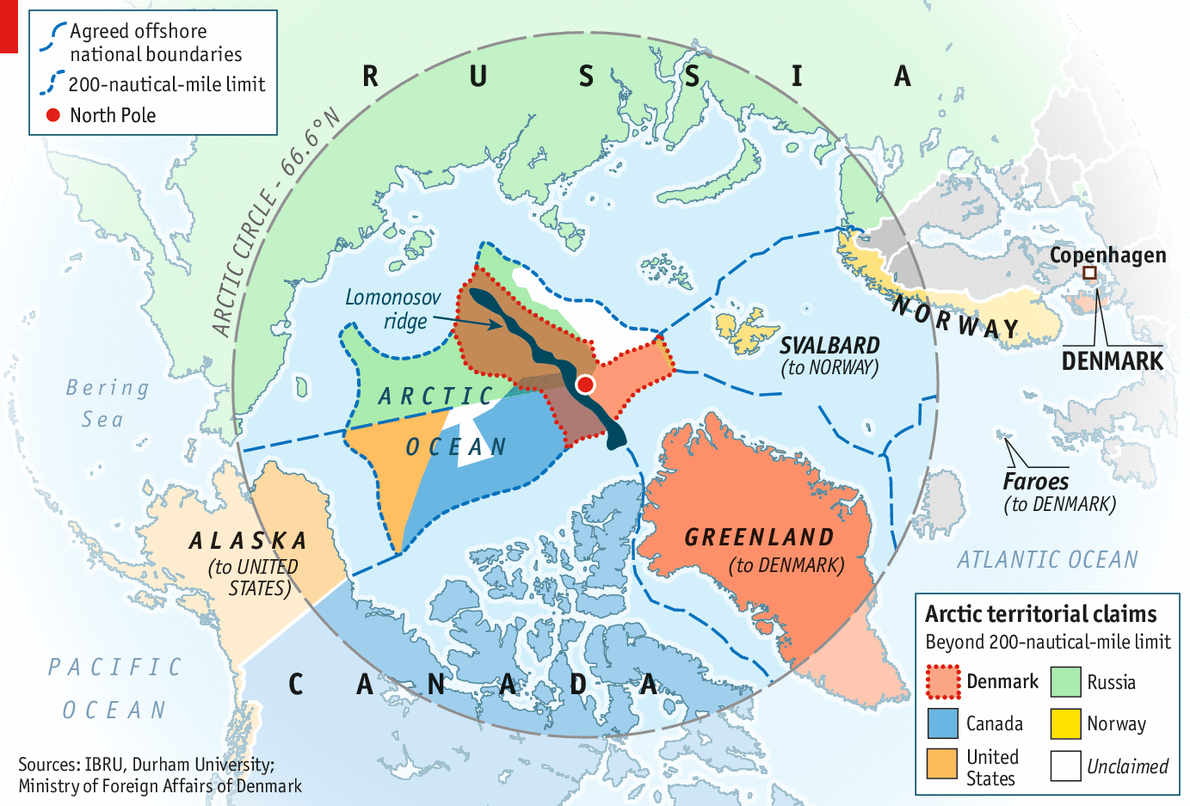
- The UN could help broker Arctic resource governance. Arctic seabed mining outside of national jurisdiction will need the International Seabed Authority (ISA) to develop regulations and protocols on environmental impact assessments for Arctic activities. Most of the Arctic Ocean floor is claimed by one continental shelf or another, but any unclaimed parts around the North Pole fall under ISA oversight. Russia, Canada, and Denmark have all made overlapping claims to the Lomonosov Ridge under the North Pole. A multilateral agreement on critical minerals among Arctic and non-Arctic nations could ensure that mining, perhaps in Greenland or Canada, ensures benefit-sharing, with an international stockpile or pricing mechanism for rare earths that reduces risks of monopolisation.
- The UN has capacity to support self-determination and rights of indigenous peoples, and could support better representation of indigenous Arctic interests in these processes. Implementing UN commitments to indigenous peoples' rights in the Arctic would mean stronger consultation mechanisms and possibly giving indigenous groups a seat at the table for Arctic resource governance.
- For Arctic shipping and infratsurcture, the UN’s IMO already has a Polar Code since 2017, imposing safety and environmental standards on ships in polar waters. The next step could be to expand into black carbon emissions or mandatory insurance for spill damages. The UN can provide the venue for negotiating these updates ensuring that, as traffic increases, it does not do irreparable harm.
The UN can always be used to convene dialogues and provide expertise and programming across issues like oil spill response, building resilient infrastructure on thawing permafrost, or energy security in remote settlements. But by building the capacity and 'good offices' for facilitating the thornier, geopolitical issues of the Arctic, the UN will not only help secure the future of the region, but could breath new purpose into multilateralism globally.
The opportunity is there. Russia needs a stable environment to attract investment for its Arctic projects and to avoid accidents that could devastate its northern communities. The U.S. and China both need the Arctic to remain peaceful so that trade can flow and climate impacts can be addressed. European nations need cooperative mechanisms to handle security and pollution. Indigenous peoples need their cross-border identities recognised in the region's governance.
The UN has a chance to articulate a common ground to build new, adaptive regimes for the Arctic, and a chance to demonstrate its own continued worth. The Arctic is a grand challenge of geopolitics, trade, and climate change. To be effective, the UN will need to relearn how to shift seamlessly across different domains of international relations, mediate great power geopolitics, and make the case for investments in new multilateral tools.
The Arctic is calling for a more dogged and confident multilateralism. The UN needs to step up and offer one.