The Mutually Beneficial G7 Bypass
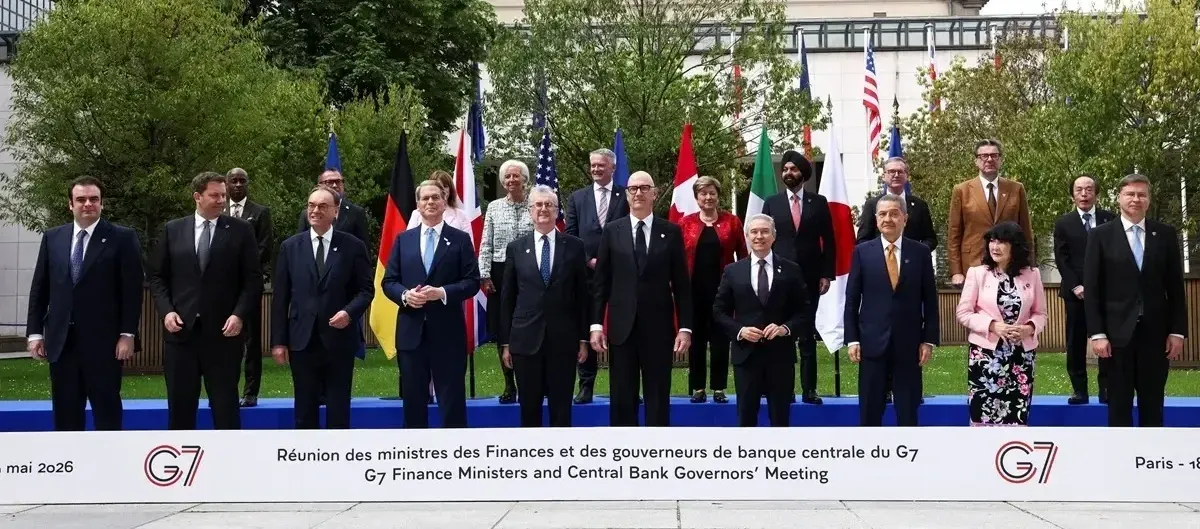
The G7 finance ministers met in Paris on 18 and 19 May 2026, consulted Brazil, India, Kenya and South Korea, and annexed to their communique a statement titled the G7 Principles for Mutually Beneficial International Partnerships. Twenty-six of thirty-four OECD DAC members cut official development assistance in 2025. The 23% contraction between 2024 and 2025 was the largest annual fall on record. Four states met the 0.7% of GNI target: Denmark, Luxembourg, Norway and Sweden.
France announced a €700 million cut in July 2025, bringing 2026 ODA to €3.7 billion. The UK is moving from a 0.7% target to 0.3% of GDP from 2027, with the difference redirected to defence, with its MENA allocation falling 45% in 2026/27. Germany, the Netherlands and Belgium are on similar trajectories. Ireland increased its programme by 4.5% to €810 million. While the American withdrawal from multilateral funding has been visible for a decade, the European retreat is recent, broad and fast.
At Davos in January, Mark Carney called the moment a rupture and set out the logic of coalitions replacing diminished institutions, "It is building the coalitions that work, issue by issue, with partners who share enough common ground to act together." The examples were a Trans-Pacific Partnership and European Union trading block of 1.5 billion people, critical minerals buyer's clubs anchored in the G7, and AI cooperation with like-minded democracies. The 2019 Alliance for Multilateralism launched by France and Germany attempted something similar and faded within two years; US allies hesitated to alienate Washington, non-democracies read it as an exclusive club, and the project appeared too embedded in European politics.
The Nordic-Canada Summit in Oslo on 15 March produced the first post-WWII formal Western alliance configuration that excluded the US. At the European Political Community on 4 May, Carney called on Europe to lead in rebuilding the international order. The French G7 presidency convened seven ministerial communiques between February and May, the Africa Forward Summit in Nairobi on 11 and 12 May, and the G7+4 finance consultation in Paris on 19 May. Évian on 15 to 17 June will host Brazil, India, Kenya and South Korea as established G7+4 partners.
How these formations relate to existing UN architecture varies. The joint G7 Development and Finance Ministers' Declaration on Domestic Resource Mobilization of 30 April places tax cooperation under OECD and G7 leadership; the UN Tax Convention, the central Sevilla Commitment vehicle for the same agenda, receives a citation without an operational role. The G7 Critical Minerals Production Alliance, established under Canada's 2025 presidency and expanded by France, runs in parallel to the UN Task Force on Critical Energy Transition Minerals; the 10 May Paris meeting added Australia, South Korea, the IEA and OECD, with no UN body in the room. However, on debt, the May 19 finance communique engages the Borrower's Platform and supports the Common Framework, and references the Spanish-led Sevilla Forum on Debt - without supplanting it. Here the G7 track is working with UN-anchored architecture rather than around it.
Western middle powers are re-organising minilateral arrangements among themselves. In most of the efforts the G7+ has put weight behind in 2026, the work is being done alongside UN process rather than within it. The G7's chosen phrase, 'mutually beneficial', has not yet drawn a response from the UN system. These powers may offer the wider UN membership a way to adapt to a chaotic new context, but any mutual benefit must extend to them too, if the new architecture is to reinforce the multilateral system rather than replace it.