The Spaces We Made
The EU is meeting with Kazakhstan for a human rights dialogue. The agenda includes sustained pressure on civil society, a new constitution rushed through a one-month drafting process with minimal civic input, and new rules increasing state oversight of foreign-funded organisations. The same week, the Asian Development Bank's $5.4 billion investment programme in Kazakhstan continues as planned. Foreign capital is seen to drive national interest while foreign-funded civil society is seen as a threat to national sovereignty. The EU will express concern.
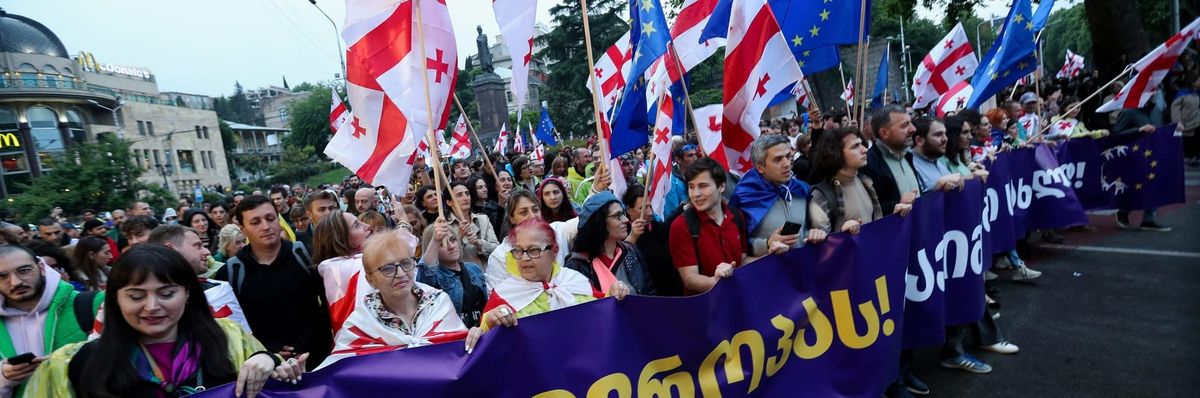
Kazakhstan is just the latest in a pattern. In early 2025, Georgian authorities froze the bank accounts of seven civil society organisations, including Social Justice Centre - a feminist legal organisation that had spent years defending workers, minorities, and LGBTQI+ communities. The mechanism was a foreign agents law modelled on FARA, targeting any NGO receiving more than 20% of its funding from abroad. Most of the affected organisations received nearly all of their funding from abroad.
Georgia is not a typical authoritarian case. It was an EU candidate state with an active, professionalised civil society built over two decades on international donor support. Tamta Mikeladze, whose organisation was paralysed within weeks of the account freezes, noted that in Russia, Azerbaijan, and Belarus the erosion of civic space took years. In Georgia, it took one. The speed reflects not just government intent but structural fragility: a civic sector with deep donor connections and shallow domestic roots.
The conventional explanation for shrinking civic space focuses on authoritarian governments and their hostility to dissent. But a donor-INGO model created this vulnerability that these foreign agents laws are exploiting. Organisations built around foreign funding, operating at arm's length from the state, oriented toward donor priorities and international advocacy norms, i.e. distinct and easy targets. The foreign agents framing works because it is, technically, accurate: the funding is foreign, and it does come with orientations and agendas.
Russia has used this framing for over a decade. Versions of its 2012 foreign agents law have spread across more than sixty countries. That the framing is deployed cynically and hypocritically, as a tool of authoritarian an imperial consolidation, does not make it completely untrue. Georgia's ruling party and the Kremlin share an interest in discrediting Western-funded civil society; they do not share it for the same reasons, and the consequences for Georgian citizens are not equivalent. But the instrument works because the dependency is real.
This dynamic is not peculiar to Russia's immediate orbit. It is the political economy of internationally-funded civil society. When the USAID collapse came, the structural impact was immediate: thousands of CSOs shrank operations, closed departments, or ceased functioning entirely. When Kazakhstan's constitutional reform removed the precedence of international treaties over national law, it was dismantling the legal architecture that Western civic engagement had treated as a foundation. The external accountability mechanism and the domestic civic space were always more interdependent than the donor model acknowledged.
There is a version of this critique that ends with recommendations: more local ownership, longer funding cycles, better relationships with state institutions. The OECD's Toolkit for Co-ordinating Action on Civic Space makes these arguments carefully. But it still misses who and what this model is for.
The stated purpose is to protect and expand spaces for civic participation: dissent, advocacy, accountability, organising. The function, in much of the Global South, has been to professionalise a specific kind of civic engagement: English-language, donor-legible, non-confrontational, oriented toward international human rights norms and away from the messier terrain of local political economy. Unions, social movements, community associations with genuine roots in domestic constituencies are systematically harder to fund, harder to partner with, and harder to defend when governments move against them, because they were never the primary beneficiaries of the model.
The Human Rights Council's 59th session in July 2025 illustrated the same logic at multilateral level. Civil society secured a resolution on civic space that recognised its role in conflict prevention. The session did not act on the UNMute Recommendations (supported by over 50 states) which called for improved access for Global South civil society to UN processes, including visa facilitation and funding for participation. Both the donor model and the UN's own efficiency drive filter participation through criteria that advantage already-legible, already-professionalised actors.
Northern donor governments fund civil society engagement partly because it serves foreign policy objectives: projecting norms, building influence, maintaining leverage in countries where direct state-to-state engagement is difficult. INGOs broker this funding in exchange for operational access and institutional relevance. The professional NGO class in the developing countries gains status, income, and international platforms. Communities gain, at best, services and advocacy that reflect their interests imperfectly and contingently.
The geopolitical dimension compounds this. When Western governments respond to foreign agents laws with aid suspensions and visa restrictions, as the US and EU did in Georgia, they confirm the framing they are trying to contest. The question of whether Georgian civil society represents Georgian interests or Western ones becomes, in that moment, more complicated to answer. Other models of support for civic legitimacy could build its domestic resource base, strengthen accountability to local constituencies, and make foreign funding more supplemental, leaving governments with less purchase on the argument that civic space is a foreign project.
The model has produced civil society sectors whose accountability runs upward to donors, to international platforms, to the norms and metrics that govern access to funding, largely at the expense of accountability to the communities on whose behalf they claim to speak. When governments move against them, there is often no domestic constituency able to mobilise in their defence. The Georgian organisations that have proved most resilient are those with the deepest community roots, not the largest donor portfolios.
The foreign agents laws, the USAID collapse, the HRC efficiency cuts are symptoms of a fragile model designed for international legibility rather than domestic legitimacy.